Theory Of Computation - Others
Table of Contents
- Table of Contents
- Regular Language and Finite Automata
- Mealy & Moore
- Context Free Grammars
- REC, RE
- Closure Properties and Undecidability
Regular Language and Finite Automata
Language
- Symbol
- Alphabet (∑)
- An alphabet is a finite, non-empty set of Symbols
- {0, 1} is a binary alphabet -=> Given by default
- { A, B, …, Z, a, b, …, z} is an English alphabet
- An alphabet is a finite, non-empty set of Symbols
- String -=> Collection of Alphabet, sequence
- A string over an alphabet ∑ is a sequence of any number of symbols from ∑
- Empty String -=> An empty string, denoted by ɛ, is a string containing no symbol -=> ɛ is a string over any alphabet
- Length of String -=> -=> It is the number of symbols present in a string (Denoted by |S|)
- Operations on Strings
- Concatenation
- The concatenation of strings x and y, denoted by x.y or xy, is a string z such that
- automata.computation = automatacomputation
- Substring
- Let x and y be strings over an alphabet Σ. The string x is a substring of y if there exist strings w and z over Σ such that y = w x z
- ε is a substring of every string
- For every string x, x is a substring of x itself
- Reversal
- The reversal of the string x, denoted by xr, is a string such that if x is ε, then xr is ε and other condition
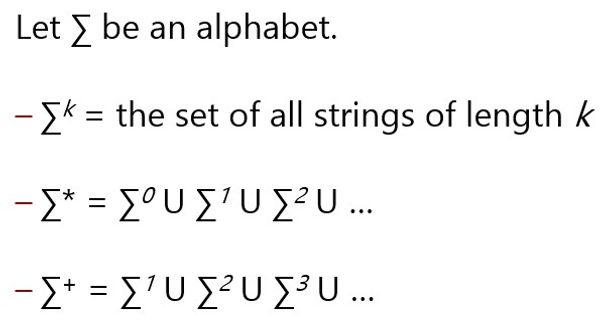
- ∑* -=> The set of strings created from any number (0 or 1 or …) of symbols in an alphabet ∑
- ∑+ -=> The set of strings created from at least one symbol (1 or 2 or …) in an alphabet ∑
- Concatenation
- Language -=> Collection of String
- Length of Language -=> Can be infinite
- Operations on Languages
- Complementation
- Union
- Intersection
- Concatenation
- Reversal
- Closure
- Kleene’s closure/star
- Kleene’s closure/plus
Automata (Machine)
- Mathematical Model/Machine to find of the given String is part of the Language
- Not possible to find it in case of infinite Length by brute force method
- Finite Automata (FA)
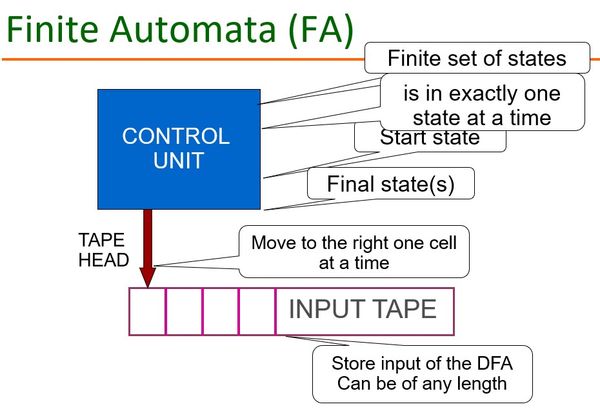
- The finite automata or finite state machine is an abstract machine that has five elements or tuples. It has a set of states and rules for moving from one state to another but it depends upon the applied input symbol
- Transition Diagram and Function
- Language that FA accept are called Regular Language
- Data Set -=> Regular expression to NFA > NFA to DFA > DFA Compression > Matching on DFA
- Types
- Finite Automata (FA)
- Pushed Down Automata (PDA)
- Linear Bound Automata (LBA)
- Turing Machine (TM)
- Power of ∑
- ∑0 -=> Set of all Strings with length 0 = ɛ or λ -=> Null String -=> Contains identity element
- ∑1 -=> Set of all Strings with length 1
- ∑2 -=> ∑.∑
- ∑* -=> Kleene Closure -=> Set of all Strings of all length possible -=> Infinite Language = (a+b)* -=> Total 2n possibility
- ∑+ -=> All Strings except ∑0 = ∑* - ɛ
Grammar
- A Grammar can be regarded as a device that enumerates the sentences of a Language
- Give you the generated Language
- A grammar G is defined as quadruple -=> G = {V, T, P, S}
- Variable -=> Can repeat, In capital letter
- Terminal -=> Terminate, In small letter
- Production -=> Rules
- Start -=> To start
- Can check if the given String is part of that Language
Chomsky Hierarchy
- Type 0 -=> Unrestricted Grammar (UG)
- Recursively Languages (RE) -=> Turing Machine (TM)
- Recursively Enumerable Languages (REC) -=> Halting Turing Machine (HTM)
- Power of DTM ≡ NTM
- Adding 1 Stack to PDA creates TM
- Adding 1 Tape to FA creates TM
- Turing Machine (TM) -=> Halting, Non-halting, Hanging, Deterministic, Non-Deterministic TM
- Type 1 -=> Context Sensitive Grammar (CSG)
- Context Sensitive Language (CSL) -=> Linear Bound Automata (LBA)
- Type 2 -=> Context Free Grammar (CFG)
- Context Free Language (CFL) -=> Non-Deterministic Push Down Automata (NPDA)
- Deterministic Context Free Language (DCFL) -=> Deterministic Push Down Automata (DPDA)
- Power of NPDA > DPDA
- Adding 1 Stack to FA creates PDA
- Type 3 -=> Regular Grammar (RG)
- Regular Language (REG) -=> Finite Automata (FA)
- Power of DFA ≡ NFA
- FA have limited memory
- NFA is used to accept Infinite REG
- x → y, x ∈ V, y ∈ T*V + T* or VT* + T* -=> Left linear or Right linear
- Regular Language (REG) -=> Finite Automata (FA)
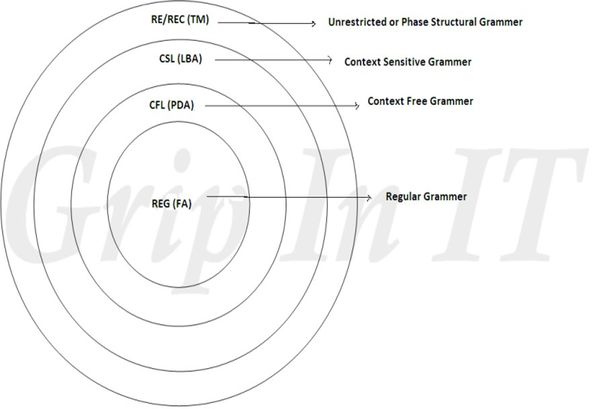
- Power -=> FA < DPDA < PDA < LBA < TM
DFA
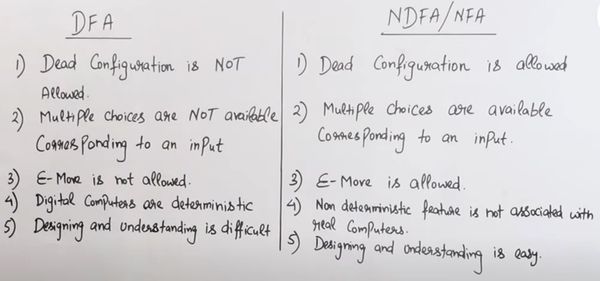
- Deterministic Finite Automata (DFA) = {Q, ∑, 𝛿, qo, F} -=> Single choice of move after applying a Symbol
- Q -=> Set of finite states
- ∑ -=> Set of Alphabet
- 𝛿 -=> Transition -=> 𝛿: Q x ∑ → Q
- If you apply any input symbol then where will it go
- qo -=> Start
- F -=> Set of finite final states -=> F ⊆ Q
- Construct/Design DFA
- Taking Complement of DFA -=> Make final → non-final & non-final → final states
- Minimum States = Length of Minimum String + 1
NDFA
- Non-deterministic Finite Automata (NFA) = {Q, ∑, qo, F, 𝛿} -=> Multiple choice of move after applying a Symbol
- Q -=> Set of finite states
- ∑ -=> Set of Alphabet
- qo -=> Start
- F -=> Set of finite final states -=> F ⊆ Q
- 𝛿 -=> Transition -=> 𝛿: Q x ∑ → 2Q
- Used to check weather a Regular language is accepted by a machine or not -=> NFA is easier to be implemented as compared to DFA
- Thompson Construction -=> Regular expression to NFA
- First we have to design its Regular expression
- Conversion of NFA to DFA
- Create Transition Table of NFA
- Create Transition Table of DFA from NFA TT
- Copy first row, then expand other states
- Initial state same and final state will be all states that contains final state of NFA
- If NFA contains n states then DFA will contain maximum of 2n states
- ɛ-NFA (Epsilon NFA)
- NFA with epsilon transitions to NFA without epsilon transition -=> Eliminating ɛ-moves
- ɛ-NFA = {Q, ∑, F, 𝛿, qo}
- Q -=> Finite set of states
- ∑ -=> Input Symbol (Alphabet)
- F -=> Set of final states
- 𝛿 -=> Transition Function -=> 𝛿: Q x (∑ ∪ ɛ) → 2Q
- qo -=> Start state
- Steps
- Find all edge starting from S2
- Duplicate all edges to S1 without changing edge labels
- If S1 in initial state, make S2 initial also
- If S2 in final state, make S1 final also
- Remove dead state
- Limitations of FSA
- Limited Memory
- Generally used for Regular Languages -=> Finite
- Strings without Comparison
- No comparison between Powers
- Linear Power
- Limited Memory
- Application of FSA
- Word Processor Program
- Digital Logic Design
- Lexical Analyzer
- Switching Circuit Design
- Text Editors
- Software for scanning large bodies of text such as Web pages to find occurrence of words, phases, patterns, etc
- Software with finite states like Vending machines, Weigh machine, Traffic lights, Toll machines, etc
- Game design like PacMan, Treasure Hunt, etc
- Minimization of DFA
- Make TT from Diagram if not given
- Mark start and final states in TT
- Remove unreachable states
- Convert states into equivalent classes
- Make one group of accepting states (final) and non-accepting states (non-final) -=> π0
- Check and Separate every two symbols if the any outputs leads to a Symbol of different groups -=> π1
- Check again like before, this time by referencing π1 -=> π2
- Now the number of remaining groups represents new states, Create the Transition Diagram
- Make TT from Diagram if not given
- Equivalence of NFA and DFA
Mealy & Moore
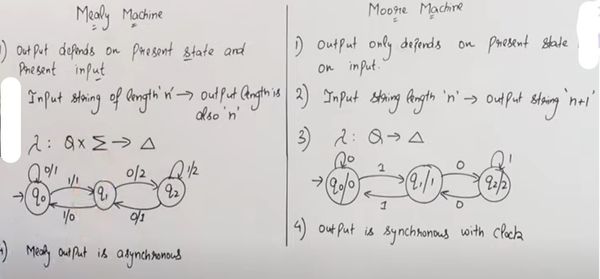
Moore Machine (Mo)
- Mo = {Q, ∑, ∆, 𝛿, λ, qo}
- Q -=> Finite set of states
- ∑ -=> Input Symbol (Alphabet)
- ∆ -=> Output Symbol
- 𝛿 -=> Transition Function -=> 𝛿: Q x ∑ → Q
- λ -=> Output function -=> λ: Q → ∆
- qo -=> Start state
- If input is of length n, then output will be of length n+1
- Transition Table
Current State Next State Output Input = a | Input = b qo - -
Mealy machine
- Me = {Q, ∑, ∆, 𝛿, λ, qo}
- Q -=> Finite set of states
- ∑ -=> Input Alphabet -=> Format = input/output
- ∆ -=> Output Symbol
- 𝛿 -=> Transition Function -=> 𝛿: Q x ∑ → Q
- λ -=> Output function -=> λ: Q x ∑ → ∆
- qo -=> Start state
- Output of state depends on input
- If input is of length n, then output will be of length n
- Transition Table
Current State Next State Output Input = a | Input = b State | Output | State | Output qo - - - Difference between Mealy and Moore
Conversion
- Moore to Mealy Conversion
- m state & n output to maximum m state
- From Transition Diagram
- Write all the states
- Write transition of each state same as Moore and output will be of state pointing towards
- From Transition Table
- Write all the columns from Moore TT except output column
- Write output corresponding to each transition equal to the output of the state it represents
- Mealy to Moore Conversion
- m state & n output to maximum m x n state
- From Transition Diagram
- Start from starting state
- Write transition corresponding to each input and write its output next to the state it is pointing towards
- If output conflict than create a duplicate state with new output
- Complete all input transition for all states, even the duplicates
Regular Expression
- Method to represent a language (Regular Languages)
- Let R be a Regular expression over ∑ if R is
- R = ɛ -=> L(R) = {ɛ}
- R = Φ -=> L(R) = {}
- R = a -=> L(R) = {a}
- R1 ∪ R2 = Regular -=> Union
- R1 . R2 = Regular -=> Concatenation
- R* = Regular -=> Kleene Closure
- If R is regular then (R) is also regular
- FA to regular expression and regular expression to FA
- Arden’s Theorem -=> Find a regular expression of a Finite Automaton
- Regular Expressions for Finite Languages
- No String -=> L = {} -=> Φ
- Length 0 -=> L = {ɛ} -=> ɛ
- Length 1 -=> L = {a, b} -=> (a + b)
- Length 2 -=> L = {ab, ba, aa, bb} -=> (ab + ba + aa + bb) = (a + b)(a + b)
- At most 1 -=> L = {ɛ, a, b} -=> (ɛ + a + b)
- At most 2 -=> (ɛ + a + b)(ɛ + a + b)
- Regular Expressions for Infinite Languages
- Symbols Used
- ∑ -=> Single 0/1
- ∑* -=> Any number of 0/1
- 1* -=> Any number of 1
- ∑+ = ∑* - ɛ = ∑∑*
- All String having single "b" -=> a*ba*
- All String having at least one "b" -=> (a+b)*b(a+b)*
- Symbols Used
- Pattern matching and regular expressions
- Regular grammar and FA
- Pumping lemma for regular languages
- To check weather the language is regular or not
- It is a negative test
- If Language fails PLT then it is not regular
- If Language passes PLT then it is not decidable
- If L is a infinite language then there exists some positive integer "n" (Positive length) such that any string W ∈ L has length greater than equal to "n", |W| >= n then W can be divided into three parts, W = xyz satisfy following conditions
- For each i >= 0, xyiz ∈ L
- |y| > 0
- |xy| <= n
Closure Properties of Regular Languages
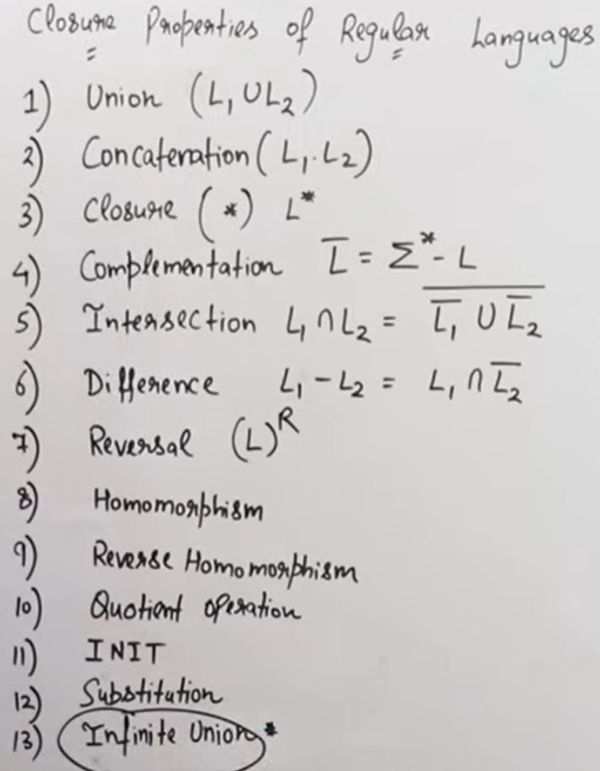
- Reversal
- Make initial state of M as final state of M
- Final state of M became initial state of M
- Reverse the direction of edges of M to make M
- No change in loop and remove unnecessary states
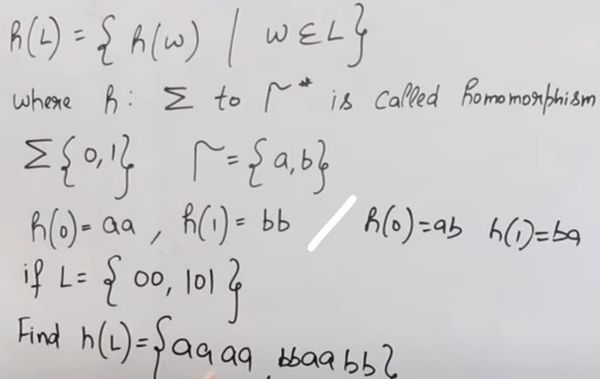
- Homomorphism
- Substitution Function
- Inverse Homomorphism
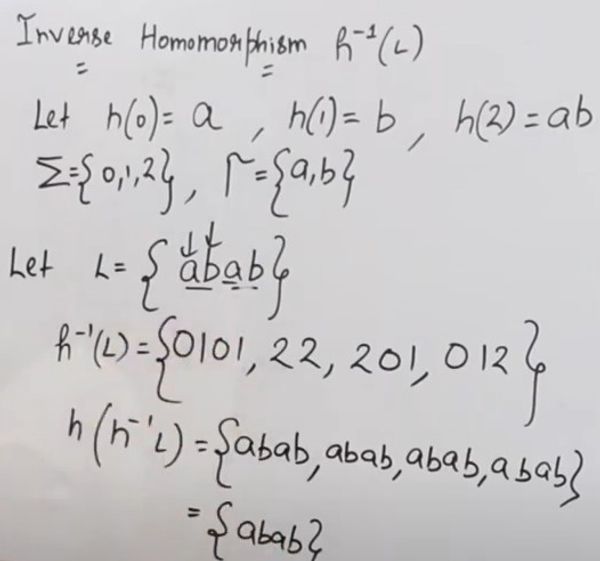
- Homomorphism of Inverse Homomorphism of a Language is subset of original Language
- Quotient Operation
- Left Quotient (Cut Prefix)
- Right Quotient (Cut Suffix)

- INIT (Initial/Prefix)
- Set of all Prefix of W ∈ L
- If making DFA for INIT then at last make all non-final states as final except traps
- Infinite Union
- Regular expression are not closed
Context Free Grammars
Context-Free Grammar (CFG)
- CFG = {V, T, P, S}
- Variable (V) -=> Finite set of variables (Non Terminal)
- Denoted by capital letter
- Can substitute Variable or Terminal
- Terminal (T) -=> Finite set of terminals (V ∩ T = Φ)
- Denoted by small letter
- Cannot substitute anything
- P -=> Production rules (Substitution Rules)
- α → β
- Only one variable in left hand side
- S -=> Start variables
- Symbol at first
- Variable (V) -=> Finite set of variables (Non Terminal)
- Convert CFL to CFG
- Derivation -=> Generating String from CFG or If a particular String belongs to that language
- LMD -=> Substitute left most variable first while creating tree
- RMD
- Derivation Tree
- Parse Trees
- Closure Properties of CFL
- Remove Null Production from CFG
- Recognize all nullable variables -=> Variables producing null directly or indirectly
- Replace nullable variable by ɛ to find new answers
- Remove ɛ from a Variable from right hand side
- If ɛ is part of Language then it can not be removed
- Remove Unit Production from CFG
- Unit Production is of the form α → β, where α, β ∈ V
- Replace the RHS of α with the RHS of β, if possible
- Remove all unutilized α -=> Those which are not reachable from starting
Push-Down Automata
- FA with Output -=> FA + Stack
- Number of comparisons of power = 1
- No choices/guess, Direct answer
- Properties
- Number of comparisons = 1
- No direct answer
- Power of NPDA > DPDA
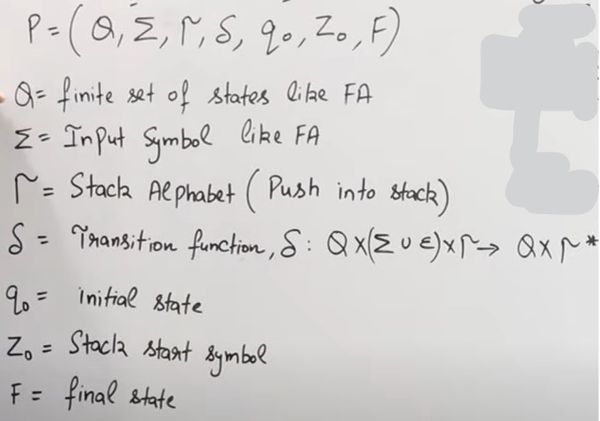
- Transition Function
- If τ and τ* are same then no change
- If τ* = ɛ then pop τ
- If τ and τ* are different push τ
- PDA Designing
- Create state diagram
- Create transitions
Others
- Ambiguity in CFG - CYK Algorithm
- Parsing
- Brute Force
- Membership Algorithm
- CYK
- Machines
- DPDA
- NPDA
- DCFL vs CFL
- Algorithm
- Removal of λ Production
- Removal of Unit
- Removal of Useless Production
- Removal of Left Recursion
- Removal of Left Factoring
- Normal Form
- Chomsky
- Greibeck
- Simplification of CFG Elimination of Useless symbols
- Normal forms for CFG: CNF and GNF
- Pumping Lemma for CFL
Context Sensitive Language (CSL)
- Number of comparisons = 2
- Linear Bound Automata (LBA)
- Turing Machine + limited size tape (Based on input)
REC, RE
- Recursive Languages
- Language that is accepted by a halting Turing machine
- Recursively Enumerable Languages
- Language that is accepted by a Turing machine -=> Also known as Countably Infinite
- Turing Machine
- Read and Write (Update) is allowed
- Can move in Right & Left direction
- Turing Machines as acceptor and transducer
- Multi head and Multi tape Turing Machines
- Universal Turing Machine
- The Halting problem
- Turing-Church thesis
- Language that is not Recursively Enumerable (RE)
- Computable functions
- Chomsky Hierarchy
- Undecidable problems
- Post's Correspondence Problem
Closure Properties and Undecidability
Closure Properties Table
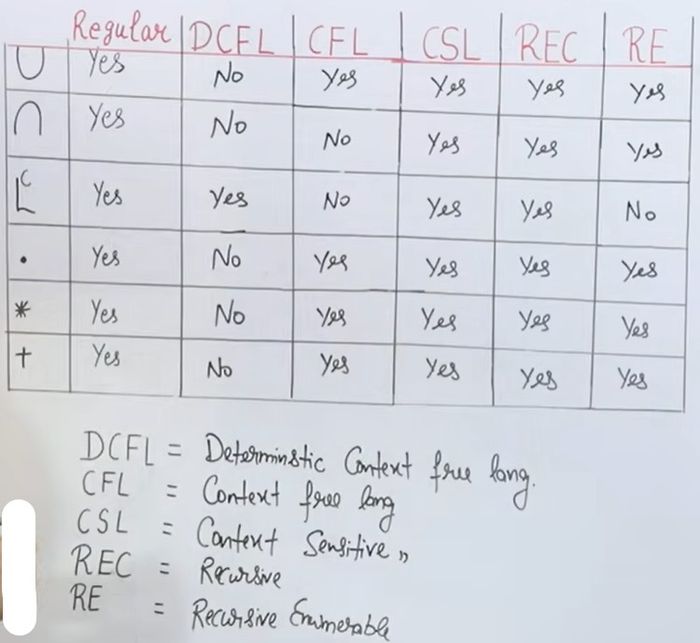
Decidable & Undecidable
- If algorithm exists for that problem then that problem is decidable
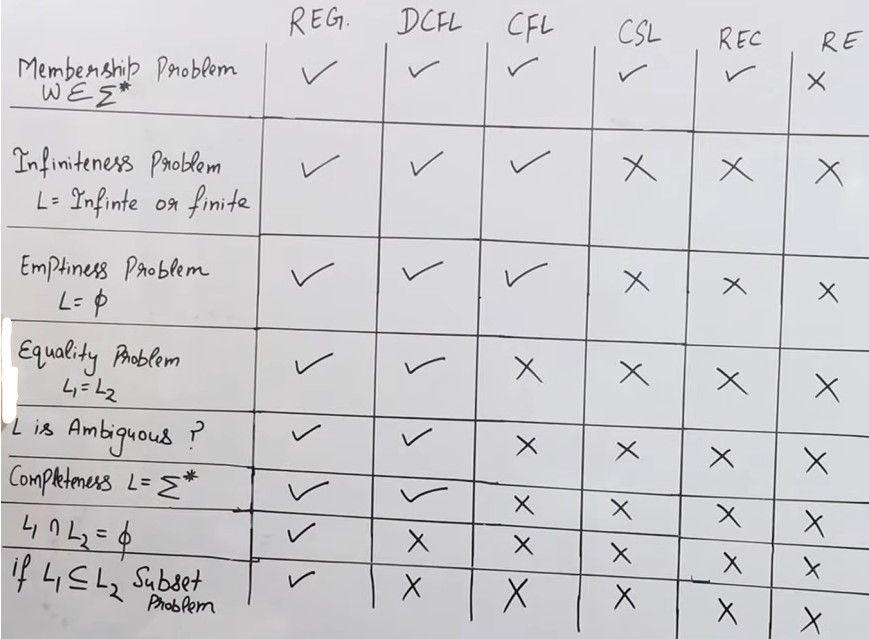
- Problems
- Membership Problem
- A particular String belongs to the Language or not
- If algorithm exists
- Finite-Infinite Problem
- Weather a language is Finite or Infinite
- Infinite if contains loop
- Emptiness Problem
- Weather a language contains nothing
- Either it does not reach final state or there is not final state
- Equality Problem
- Weather two languages of same type is equal -=> Accepting same type of string
- Ambiguity Algorithm
- L is Ambiguous
- A given Grammar is ambiguous if there is a sentence with moe than one derivation tree corresponding to it
- Completeness Problem
- Weather the language is contains all possible Strings for input given
- Intersection Problem
- Weather the intersection of same type of languages is empty
- Subset Problem
- Weather the languages of same types are subset of each other or not
- Membership Problem