Introduction - Microprocessor And Interfacing
- Evolution of Microprocessor
- First Generation (1939 - 1954)
- Second Generation (1954 - 1959)
- Third Generation (1959 - 1971)
- Fourth Generation (1971 - Present)
- Microprocessor
- Scaling from 4004 to pentium 4
- Identified with word size of data
- Types
- 4-bit Processor
- ALU can perform 4 bit data operation at a time
- INTEL 4004, INTEL 4040
- 8-bit Processor
- 8008, 8080, 8085, MOTOROLA 6800 (M6800)
- 16-bit Processor
- 8086, 8088, ZILOG 2800, 80186, 80286
- 32-bit Processor
- INTEL 80386, 80387, 80486
- INTEL PENTIUM, INTEL PENTIUM PRO, INTEL PENTIUM II, INTEL PENTIUM III, INTEL PENTIUM IV
- INTEL DUAL CORE
- 64-bit Processor
- Speed is very fast
- INTEL CORE 2
- INTEL CORE I7
- INTEL CORE I5
- INTEL CORE I3
- Microprocessor
- Basic
- Also known as CPU, Brain of microcomputer, Stand-alone
- A single chip, Present in the motherboard
- Controls all the components -=> Memory, IO Devices, External Devices
- High level language > Assembly language > Machine language
- Executes sequence of instruction
- It fetch, decode and execute the instructions
- Designer can decide on the amount of RAM, ROM, I/O Devices
- Expensive, Versatility, General Purpose
- High processing power, High power consumption
- Instruction sets focus on processing intensive operations
- Typically 32/64 bits
- Typically deep pipeline (5-20 stages)
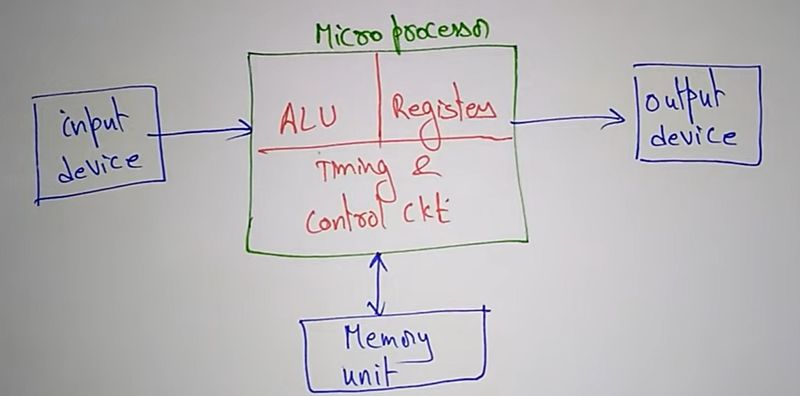
- Components
- Registers
- Temporary storage location for performing instruction
- Arithmetic Logical Unit (ALU)
- Performs all arithmetic and logical operations
- Timing and Control Unit
- Keeps all other parts of system (Registers, ALU, Memory, I/O) working together in right time sequence
- Connected with
- Input
- Used to give the input data to Microprocessor
- Output
- Used to provide the result of calculation
- Memory
- Used to store the data
- Bidirectional
- Microcontroller
- Basic
- Integrated electronic computing device that includes CPU, RAM, ROM, I/O, Timer all in a single chip
- Used for applications in which cost and space are critical
- Single purpose (Control oriented), Low processing power, Low power consumption
- Instruction sets focus on control and Bit-level operation
- Typically 8/16 bits
- Typically single cycle or two stage pipeline
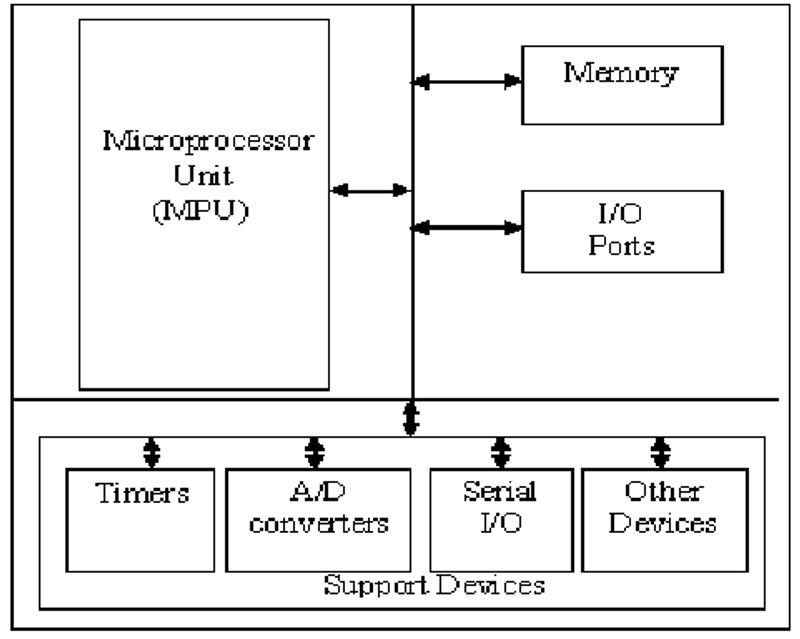
- Components
- Microprocessor
- Memory
- I/O Ports
- Supporting Devices
- Timers
- Analog to Digital (A/D) convertors
- Serial I/O ports
- Common Communication Lines
- Memory
- Storage device
- Address
- In terms of Binary numbers
- Data lines
- Registers
- Main category
- Read/Write Memory (RAM)
- Data is erased when system is turned off
- Read only Memory (ROM)
- Data is stored permanently
- I/O Devices
- Input Devices
- Switches and Keypads
- Provide binary operations to the Microprocessor Unit (MPU)
- Output Devices
- LED's and LCD's
- Receive binary information from the Microprocessor Unit (MPU)