Introduction - Image Processing
- Image Processing Fields
- Computer Graphics -=> The creation of images
- Image Processing -=> Enhancement or other manipulation of the image
- Computer Vision -=> Analysis of the image content
- Image Sampling & Quantization
- The output of most sensors is continuous in amplitude and spatial coordinates
- Used to convert analog image into digital image
- Components
- Coordinates
- Intensity/Amplitude
- Sampling
- Process of digitizing of coordinates of analog image and into digital image
- Nyquist sampling rate
- 2 * Maximum Frequency
- Aliasing
- Quantization
- Process of digitizing of amplitude of analog image and into digital image
- Rounding off
- Truncation
- Steps
- Dividing axis in equal parts
- 3-bit Quantizer
- Convert points into bits
- High intensity area will get higher pixel value (Up to 255)
- Representing Digital Images
- Pixel intensity levels (gray scale levels) are in the interval of [0, L-1]
- L = 2k
- Bits required to store a digitized image, b = M * N * k
- Basic Relationship of Pixels
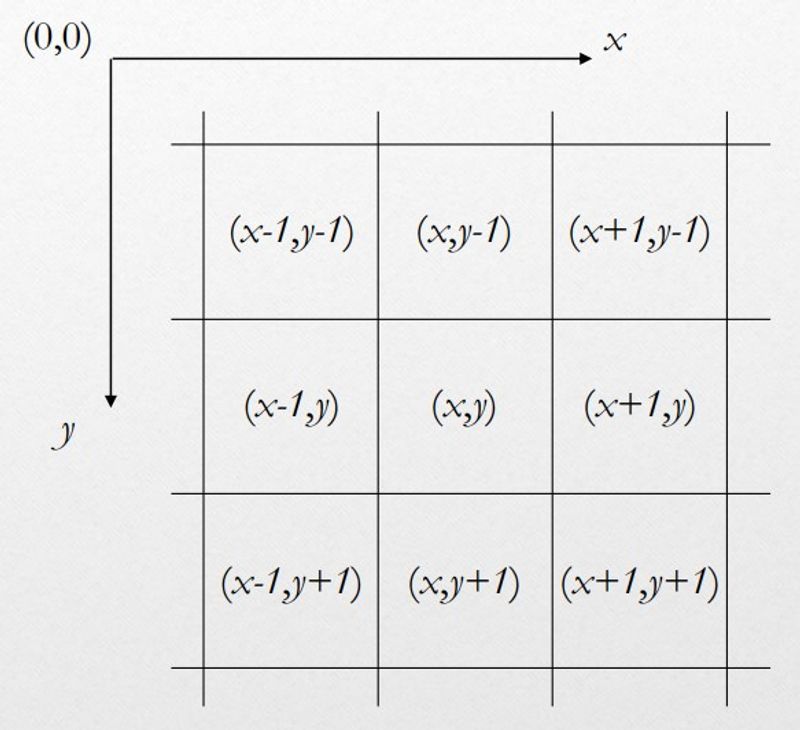
- Neighbors of a Pixel
- N4(P) = 4-neighbors -=> Considers only vertical and horizontal neighbors
- N8(P) = 8-neighbors -=> Considers all neighbors
- ND(P) = 4-neighbors -=> Considers diagonal neighbors
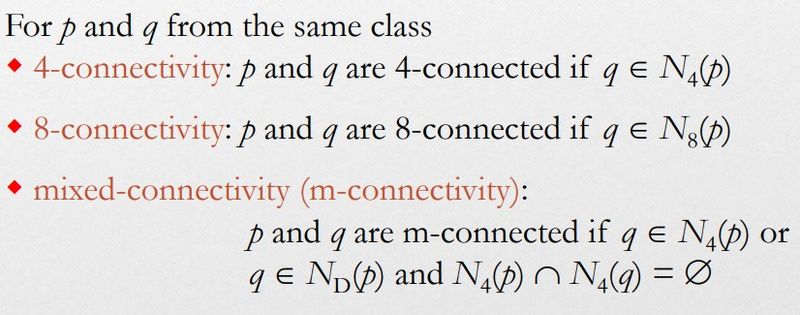
- Connectivity
- Adjacency
- A pixel p is adjacent to pixel q then they are said to be connected
- Type -=> 4-adjacency, 8-adjacency, m-adjacency
- Path
- A path from pixel p at (x,y) to pixel q at (s,t) is a sequence of distinct pixels
- Type -=> 4-path, 8-path, m-path
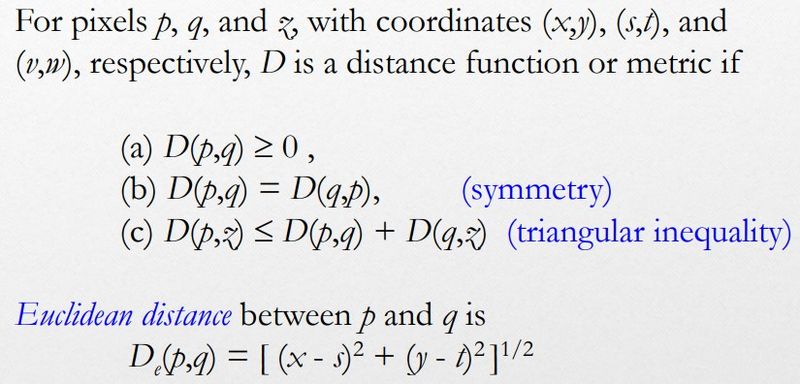
- Distance Measure
- Euclidean
- City block
- D4(p,q) = |x - s| + |y - t|
- Chessboard
- D8(p,q) = max(|x - s|, |y - t|)
- Distance Measure of Path
- Path Length