A Digital image is an image composed of picture elements, known as pixels, each with finite discrete quantities of numeric representation for its intensity or grey-level that is an output from its 2-D function fed as input by its spatial coordinates denoted by "x" and "y"
An image can be defined as a two-dimensional function f(x,y)
x,y -=> Spatial coordinate
f(x,y) -=> The amplitude, called the intensity or gray level of the image at that point
Digital Image Processing
Use of digital computers to process digital images through an algorithm
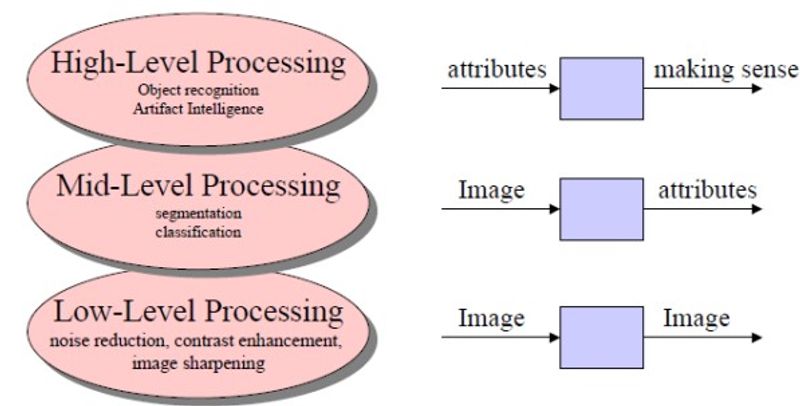
Processes
Low-Level Processes
Input and output are images
Tasks (Primitive operations)
Image processing to reduce noise
Contrast enhancement
Image sharpening
Mid-Level Processes
Inputs, generally, are images
Outputs are attributes extracted from those images -=> Edges, Contours, Identity of individual objects
Tasks
Segmentation -=> Partitioning an image into regions or objects
Object Classifications/Recognition
Description of those objects to reduce them to a form suitable for computer processing
High-Level Processes
Recognition of individual objects
Tasks
Image analysis and Computer vision
Understanding or Autonomous Navigation
Pixel
It is the smallest controllable element of a picture represented on the screen
Simple Image Formation Model
Each pixel corresponds to light intensity normally represented in gray scale (gray level)
When an image is generated from a physical process, its value are proportional ot the energy radiated by a physical source (Electromagnetic waves)