Components In Dip - Image Processing

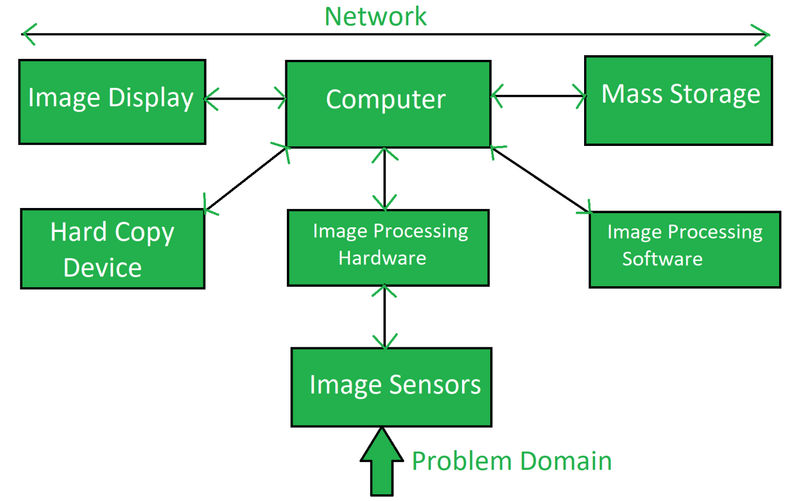
  • Elements
  • Image sensor
    • Two elements are required to acquire digital images
      • Physical device
        • Sensitive to the energy radiated by the object
        • Senses features like Intensity, Amplitude, Coordinates
      • Digitizer
        • Converting the output of the physical sensing device into digital form
  • Image Processing Hardware
    • Consists of Digitizer
    • Hardware that performs other primitive operations, such as an arithmetic logic unit (ALU)
    • This type of hardware sometimes is called a front-end subsystem, require fast data throughput that the typical main computer cannot handle
  • Computer
    • General-purpose computer and can range from a PC to a supercomputer
  • Image Processing Software
    • Consists of specialized modules that perform specific tasks
    • Also includes the capability for the user to write code that
  • Mass storage
    • And image of sized 1024 * 1024 pixels requires one megabyte of storage space
    • Digital storage
      • Short-term storage for use during processing
        • Computer memory, Specialized boards (Frame buffers)
      • On-line storage for relatively fast recall
        • Magnetic disks and Optical-media storage
        • Frequent access
      • Archival storage, characterized by infrequent access
        • Massive storage requirements but infrequent need for access
  • Image displays
    • The displays in use today are mainly color (preferably flat screen) TV monitors
  • Hard-copy device
    • Used for recording images, include laser printers, film cameras, heat-sensitive devices, inkjet units and digital units, such as optical and CD-Rom disks
  • Networking
    • Everything connected to network
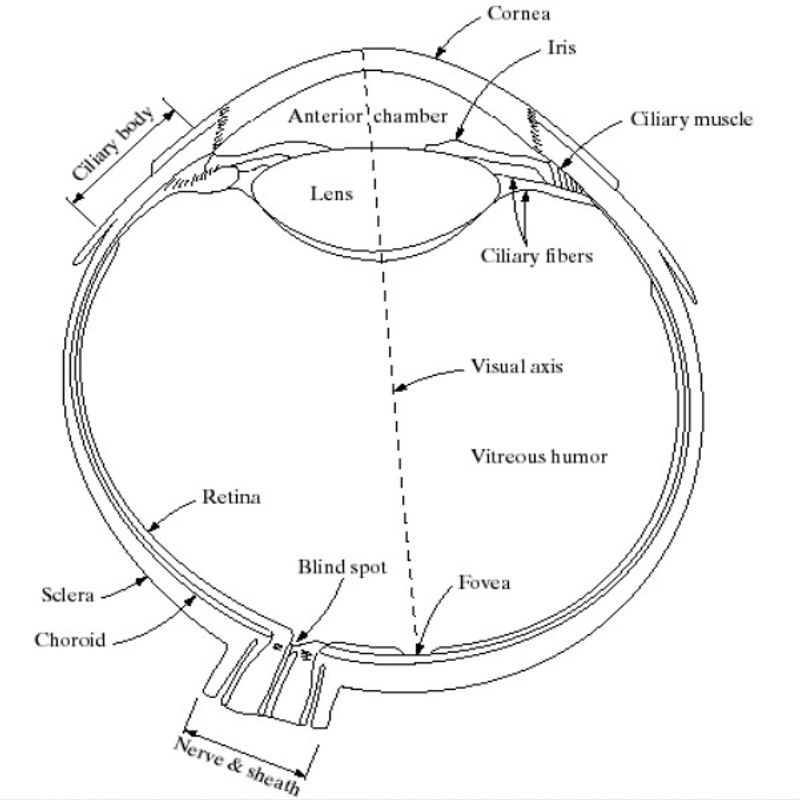
  • Human Eye
    • Human Eye
    • Light Receptors in Retina
      • About 6-7 millions cones for bright light vision called photopic
      • About 75-150 millions rods for dim light vision called scotopic
    • Fovea
      • Photoreceptors around fovea responsible for spatial vision (still images)
      • Photoreceptors around the periphery responsible for detecting motion
    • Image Formation
      • Normal Focus
      • Nearsighted Focus
      • Farsighted Focus
    • Simultaneous contrast
      • All small squares have exactly the same intensity but they appear progressively darker as background becomes lighter
    • Optical illusion
Share: